
The Pulp Factory
by Zoe Newton
The Pulp Factory: mechanical pulp press, dehydrator and storage.
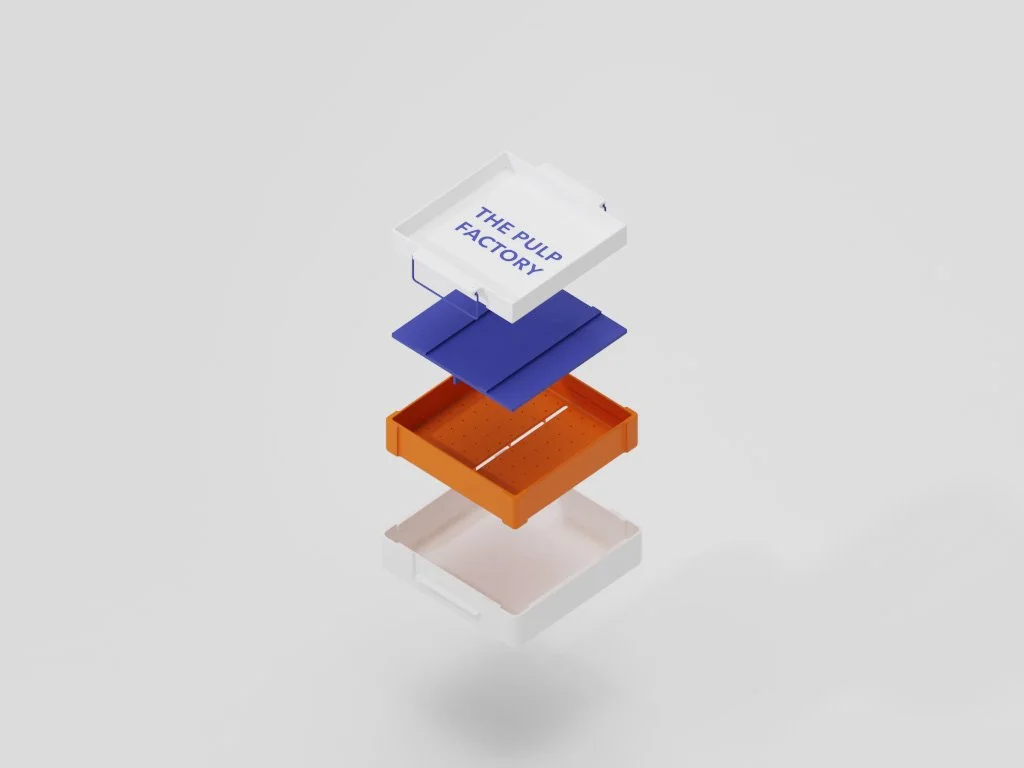
Mould set for producing pulp products
Abstract
"Overconsumption and poor waste management habits have resulted in rapid environmental decline. A shift towards environmentally conscious products and processes is needed on both an industrial and individual level.
Despite large-scale efforts to reduce and reverse these effects, the issue of inadequate waste education standards has failed to equip the next generation with effective tools to combat this decline.
Current educational programs encourage the use of recyclable waste items as vessels for creative lessons; however, these creations do not educate students on the value of the waste materials, instead, they create unrecyclable waste through the fusing of multiple materials together. These practices are not teaching environmentally conscious behaviours and contribute negatively to waste streams as a result.
The Pulp Factory investigates the potential for student involvement in the upcycling of school waste streams, exposing children to the value of waste materials through a codesign process of ideation, material collection and production, providing autonomy and agency to young creative minds. In-depth, material and form testing, using resources from within education spaces, allowed for the development of a process and accompanying artefact that elicits excitement for the users.
The final product focuses on children as the sole users and scales down large-scale machinery to be approachable and safe within a classroom environment. The paper pulp products aim to utilise as much school waste as possible, showcasing the material potential that education spaces produce."
“The issue of inadequate waste education standards has failed to equip the next generation with effective tools to combat this decline. ”
Paper pulp pencil trays, and paint palettes
Design Intent
"The purpose of this study is to break the cycle of poor waste education standards by providing young students with an opportunity to experience the importance of design and understand the value of waste materials through a co-design upcycling process. This project differs from existing educational models and challenges students to find solutions to design problems backed by their understanding of the paper pulp up-cycling process. I hope that by exposing children to the potential of waste materials from a young age, lifelong sustainable behaviours will be established.
Research questions that will guide the completion of the dissertation:
1. How can an educational program instil sustainable attitudes and behaviours?
2. In what ways can recycled products be implemented without encouraging unsustainable behaviours, making existing products redundant?
3. How can waste produced from education systems be given a new life beyond its initial use?
4. In what ways can participatory processes that educate, inspire new attitudes to recycling?"
“ This project differs from existing educational models and challenges students to find solutions to design problems backed by their understanding of the paper pulp up-cycling process. ”
When the safety shield is disengaged, stopper blocks wheel movement.
When the safety shield is engaged, wheel movement is allowed.
Bio
I’m Zoe!
I am a designer with a fascination and skill based around iterative, human-centred design. With a deep foundation of technical hands-on skills, I strive to develop products with functional excellence and aesthetic clarity. Thorough problem solving through design practice enables me to produce designs that address users’ needs, not only improving their quality of life, but also making products that are exciting to use. Some of my most recent projects have been inspired by my work in childcare, focusing on new ways to excite learning and encourage autonomy.
previous project / next project
Copyright UTS Product Design 2026