
BIOBUOY
by Minjun Minty Jo
Hero shot render of BIOBUOY in situ.
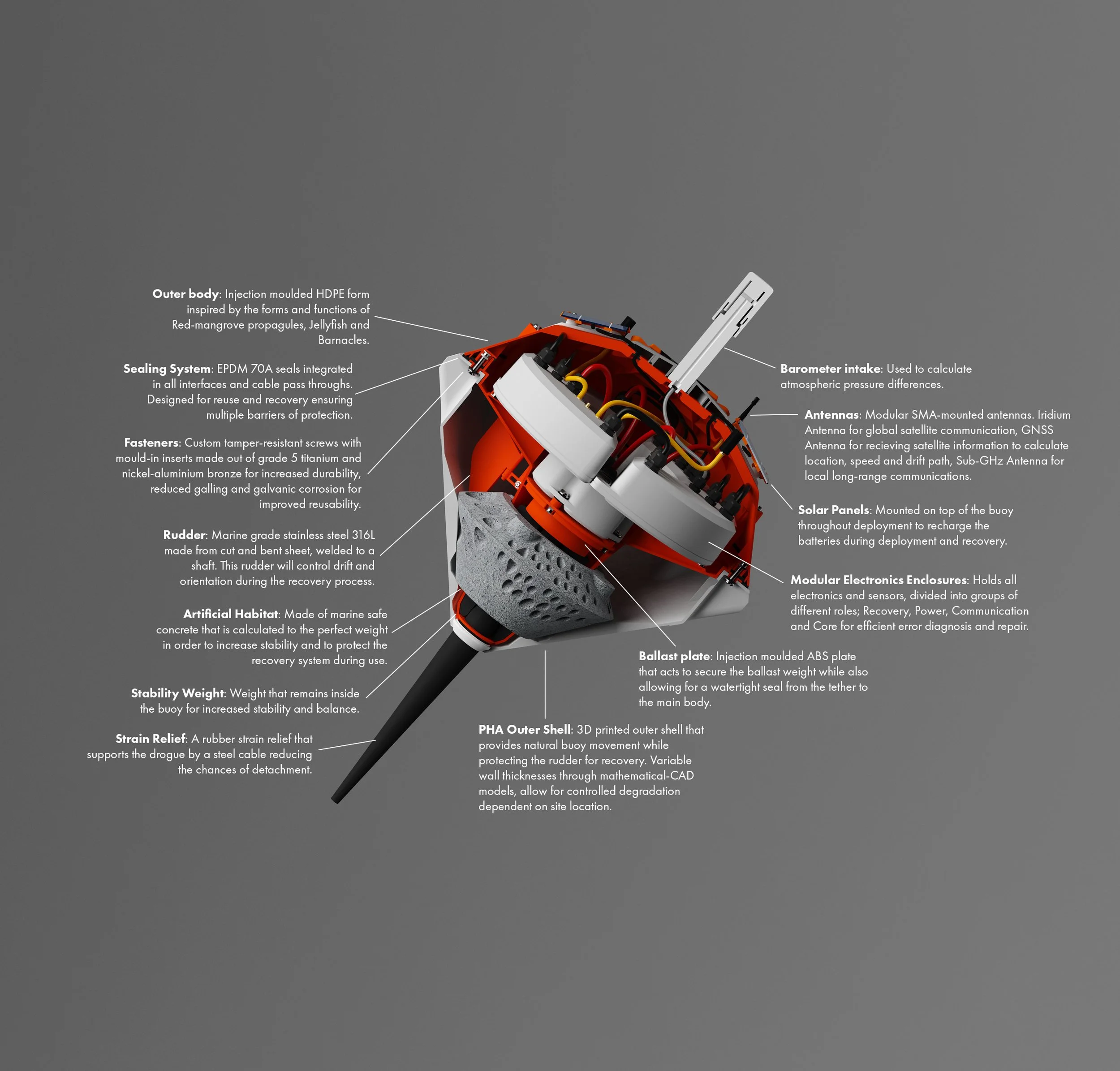
Cross-section labelled diagram of BIOBUOY.
Abstract
This project explores how unrecovered drifting buoys often become long-term plastic and electronic waste despite their crucial role in monitoring ocean behaviour and climate. This project followed a research-led design approach, critically examining existing products, manufacturing processes, and material choices to identify opportunities for more sustainable alternatives. By integrating circular design strategies and biomimicry, the study proposes a new drifting buoy designed to operate harmoniously with marine ecosystems.
A key part of this project is polyhydroxyalkanoates (PHA), a fully biodegradable biopolymer capable of breaking down in marine environments without leaving microplastics. The design draws inspiration from natural systems such as red mangrove propagules and barnacles to inform both the form and function of the buoy, focusing on hydrodynamic efficiency, durability, and the potential for guided recovery. Additionally, a modular design strategy was used to further support circularity by enabling the repair and reuse of components, reducing waste.
Several qualitative and practical methods were used, including material testing, wave tank testing, fluid dynamic simulations and scaled physical prototyping. FDM 3D printing was chosen as the primary method of prototyping and manufacturing with PHA due to its accessibility. Scaled-down FDM prototypes were printed to test waterproofing and biomimetic forms, showing that waterproofing was possible with FDM through increasing wall thicknesses, though unsuitable for underwater pressure. In wave tank testing, a red-mangrove propagule-inspired form proved the most effective, allowing for a lower centre of gravity, producing the most consistent and predictable drift behaviour. Computational fluid dynamics (CFD) simulations were used to better understand the hydrodynamic performance of existing SVP buoy forms. While not conducted at an engineering level, these simulations were informed by publicly available ocean current data and served as a valuable tool to visualise flow behaviour, drag, and potential pain spots for wear and tear.
The results provided a strong starting point for identifying design improvements, even if not fully precise or comprehensive. Modularity and reassembly were tested in scaled models, and a recovery system was proposed where buoys regroup using GPS and an automatic rudder, allowing a single vessel to collect and redeploy them. The result is a more sustainable drifting buoy concept that bridges performance with environmental responsibility through systems thinking, material innovation and nature-inspired design.
“The design draws inspiration from natural systems such as red mangrove propagules and barnacles to inform both the form and function of the buoy, focusing on hydrodynamic efficiency, durability, and the potential for guided recovery.”
Hero shot render of BIOBUOY in situ.
Design Intent
This project aims to reduce the long-term environmental impact of drifting buoys by implementing sustainable design principles, including circularity and sustainability. Drifting buoys are rarely recovered after their service period and contribute to marine pollution through the spread of NIS, microplastics and electronic waste. This project aims to take a research-led design approach and explore how biodegradable materials, modular design and biomimicry can be implemented to design both functional and more environmentally responsible drifting buoys.
“This project aims to take a research-led design approach and explore how biodegradable materials, modular design and biomimicry can be implemented to design both functional and more environmentally responsible drifting buoys.”
Exploded view render of BIOBUOY.
Before and after render of artificial habitat.
Before and after render of BIOBUOY drop-off and pick-up.
Bio
I am a product design honours student at the University of Technology, Sydney, passionate about creating innovative and sustainable solutions to complex challenges. My work is driven
by precision and a strong attention to detail, emphasising practical, hands-on problem-solving. I’m particularly interested in the digital aspects of design and have developed skills in CAD software and 3D printing, allowing me to bridge traditional craftsmanship with modern technology.
Copyright UTS Product Design 2026