
Pyron
by Rohan Sivanathan
Pyron in situ
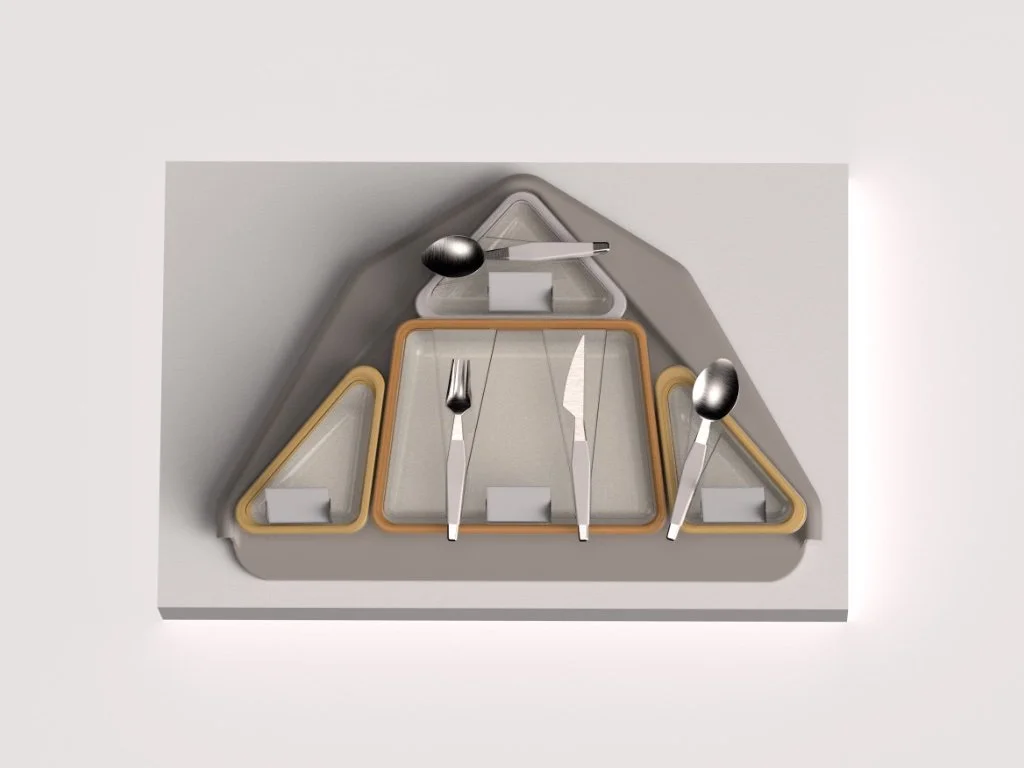
Top View of Pyron, showing the food pyramid design metaphor
Abstract
Hospitals generate an enormous amount of food waste every year. This comes at a cost for the environment and the economy, as well as having devastating health impacts. Hospital food waste is integral to address, as the medical industry wastes a proportionately higher amount of food than other sectors like hospitality. Some interventions to address hospital food waste do exist, but certain elements of their concept and implementation fail to address the issue in a meaningful and human-centred way.
This study explores this opportunity to address hospital food waste with a human-centred product design. The project investigates the hospital inpatient’s consumption experience, to address the issues of patient consumption, patient nutrition information and patient mood, through a product redesign. This exists in the form of a hospital food tray and crockery set, developed with a Constructive Design research methodology; combining design and research principles into one unified research and design development process.
The project aims to nudge patient behaviours towards better consumption habits to reduce plate waste through a product design perspective. It additionally seeks to serve as something of an early enquiry into the cross section of food waste and product design, as design principles were found to be an under-explored method for addressing food waste.
“The project investigates the hospital inpatient’s consumption experience, to address the issues of patient consumption, patient nutrition information and patient mood, through a product redesign.”
Pyron's components
Design Intent
Pyron seeks to improve patient nutrition and lessen hospital plate waste through a redesign of hospital food tray sets, implementing nudge theory and human-centred design principles. Every year in Australia, 251,000 tonnes of hospital food are wasted. Food waste itself can be divided into multiple categories, with the largest contributor in hospitals being plate waste, which pertains to the food left behind on the plate by the consumer. Studies show that plate waste is driven by the actions and experience of the key stakeholder, the patient. By addressing the experience of the key stakeholder, meaningful change can be made. Diving into the experience of the hospital patient, there is a recurring issue of poor nutrition in hospital patients, hospital meals are designed to provide patients with the nutrition they need and most of it is going to waste. Research findings indicated that there is an opportunity for patients to be encouraged towards better consumption habits, as well as potential for patients to be better informed about their nutrition. Pyron draws upon size, colour and location hierarchy, product metaphor and modularity in a product design created to be material, size and aesthetically appropriate for the hospital environment.
“Diving into the experience of the hospital patient, there is a recurring issue of poor nutrition in hospital patients, hospital meals are designed to provide patients with the nutrition they need and most of it is going to waste.”
Pyron variants for different hospital meal setups
Pyron in situ, on a hospital bed table
Bio
As a Product Design Honours student, I’m drawn towards creating with a human-centred design framework. Whilst completing my Diploma of Innovation, I’ve developed an interest in investigating complex problems and how my product design background can inform results. The exciting opportunity and privilege to design for meaningful change has directed the projects I choose to take on, as well as how I carry them out.
previous project / next project
Copyright UTS Product Design 2026