
A Helping Hand
by Elizabeth Wong
Customised handgrips on rollator frame
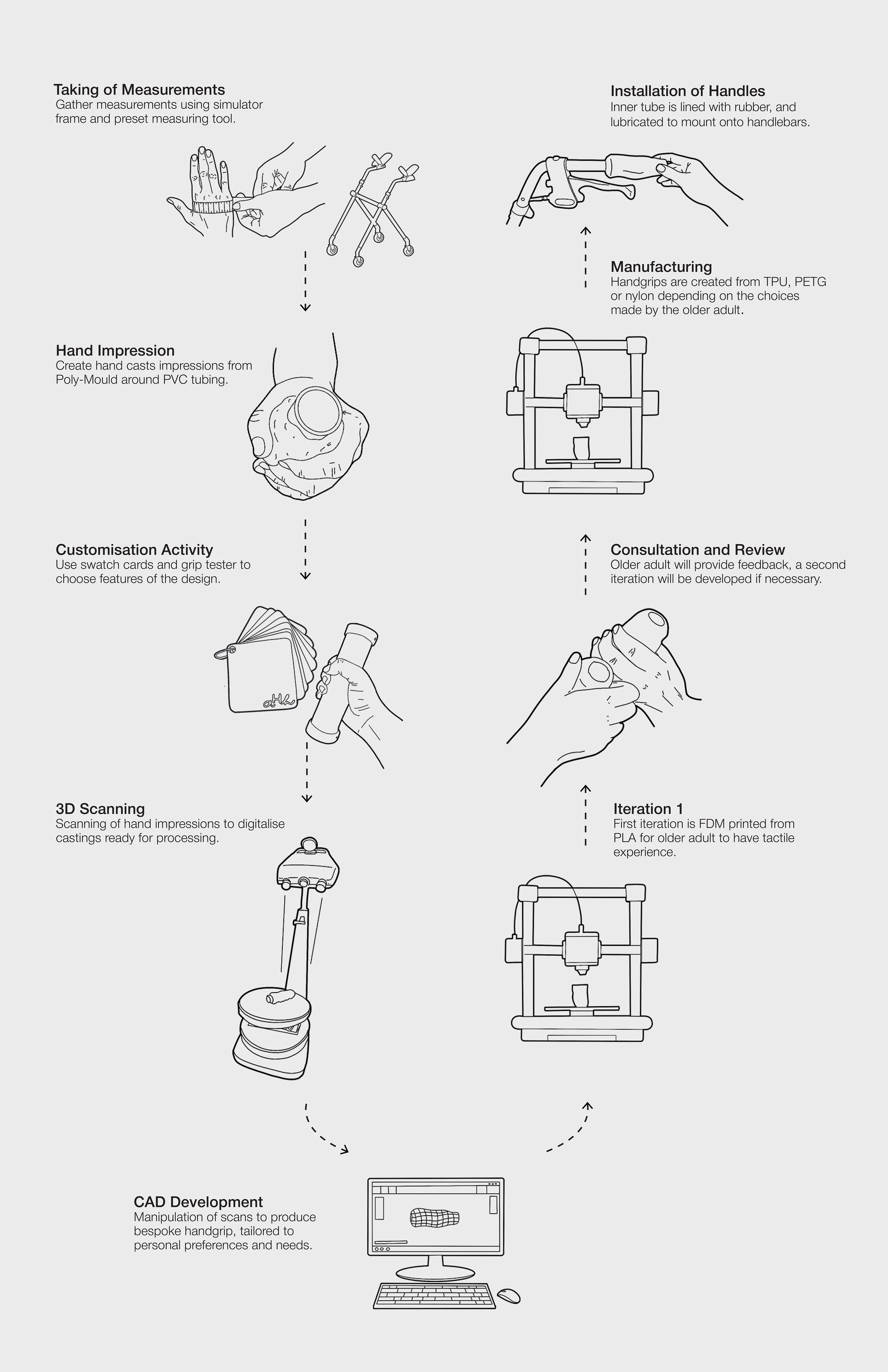
A Helping Hand co-design process
Abstract
As the global average population becomes progressively older, it is imperative for designers to create products and systems that are accessible to a diverse range of ages. As human bodies age, they become more susceptible to injury due to weakened muscles or joints. This project investigates employing co-design principles and advanced manufacturing technologies to create customised rollator handgrips with older adults. Rollators provide stability for individuals with reduced mobility or who might be cautious of walking independently; such as older adults.
This project adhered to a research-led design approach, implementing a user-centred design methodology accompanied by physical prototyping and conceptual frameworks, to structure the design process from ideation to realisation. Methods such as experimental models, reviewing literature on hand function, and user testing with older adults, were employed to enhance the understanding of the physiological and psychological aspects of aging bodies. User testing with tools developed to facilitate the co-design process and concept models were an integral part of this human-centred design, as it provided profound insights into user needs and preferences.
It was discovered that older adults were empowered to continue participating in mentally stimulating activities, and because they were stakeholders in the creation of the handgrips, they felt a deeper connection to the product, rather than viewing it solely as a medical aid. Significantly, individuals who experienced discomfort from their generic handgrips reported that the new handgrips reduced grip pain. The importance of this practice-based approach fosters the creation of new meanings and values when applying co-design principles with older individuals.
“As the global average population becomes progressively older, it is imperative for designers to create products and systems that are accessible to a diverse range of ages.”
Preset targeting Arthritis symptoms
Design Intent
Standard rollator handgrips are typically mass-produced and designed with a one-size-fits-all approach, failing to address the diverse ergonomic and comfort needs of older users. This lack of customisation can lead to discomfort, reduced usage, and decreased mobility confidence. Furthermore, older adults are often excluded from the design process, resulting in products that do not reflect their lived experience or preferences, highlighting a clear need for more inclusive and participatory design processes that create solutions tailored to individual users.
This research project aims to develop a co-design methodology for creating customised rollator handles for older individuals to be fitted onto their existing rollator frames. Rather than replacing the entire mobility aid, incremental change can foster a sense of familiarity while improving comfort, ergonomics, and user satisfaction. Additionally, the co-design process should encourage creativity and autonomy in decision-making for the older individual, and provide opportunities for them to gain new knowledge about advanced manufactruing technologies such as 3D scanners and 3D printers.
By doing so, the project challenges traditional industrial design methods and shifts common perceptions of addressing a “difficult” demographic. Designing with older adults reflects inclusive design, accounting for diverse physical and cognitive abilities while encouraging simplicity, flexibility, and ease of use for individuals of all ages. Additionally, the use of advanced manufacturing in creating these niche products highlights the versatile capabilities of these technologies.
“ Older adults are often excluded from the design process, resulting in products that do not reflect their lived experience or preferences, highlighting a clear need for more inclusive and participatory design processes that create solutions tailored to individual users.”
Preset targeting Parkinson's disease symptoms
Vertically orientated preset with detachable wrist rest to minimise wrist strain
Wrist rest compliant mechanism fixing
Bio
Elizabeth is a product design honours graduate with a strong interest in human-centred design. She has a passion for creating products that enhance the quality of life for people of all ages and abilities. Elizabeth is a keen problem solver with a strong attention to detail. Through her work at an aged care facility, she has learnt first-hand the importance of allowing and encouraging older people to make their own choices, as well as how assumptions about capability can reduce an older individual’s confidence and ability to self-govern. Therefore, Elizabeth believes there is a significant opportunity to use design as a tool to improve the well-being of users, and how implementing participatory and co-design processes when developing products respects individuality and responds to real needs rather than perceived ones.
previous project / next project
Copyright UTS Product Design 2026