
On Repair: Examining a Repairable and Accessible Speaker Enclosure
by Jeremiah Royal
Hero shot of interaction prototype
Rendered in context of the Alumax Stack
Abstract
This dissertation explores the potential of repair in hi-fi loudspeakers, aiming to create durable, accessible, and environmentally friendly products. It investigates traditional and modern assembly methods, focusing on metal frames for repeat assembly and disassembly and novel manufacturing techniques. Secondary research, product autopsies, and prototyping analyse existing speaker designs, materials, and manufacturing methods.
User surveys and interviews offer insights into consumer knowledge, perceptions, and behaviours regarding speaker use and disposal, identifying key challenges in fastening and sealing while proposing modular enclosure solutions. Australia's resource and waste management issues form the project's backdrop, addressing its underdeveloped manufacturing sector and inadequate waste practices despite its developed status. As Australia shifts towards a circular economy emphasising waste prevention, reuse, and repair, design is crucial in driving this transition. Current legislation focuses on recycling but overlooks repairability and longevity. Concepts like continuous design and degrowth offer a vision for systemic change in resource management, production, and consumption. The project aims to create a sustainable, durable, and customisable speaker design accessible to diverse users. Promoting sustainable materials and standardised frameworks contributes to developing repairable, high-quality electronics. This work hopes to inspire a shift in production and consumption, fostering a sustainable and equitable future while continuing the dialogue on waste, repair, and design.
“Promoting sustainable materials and standardised frameworks contributes to developing repairable, high-quality electronics. This work hopes to inspire a shift in production and consumption, fostering a sustainable and equitable future while continuing the dialogue on waste, repair, and design. ”
Key features of the enclosure.
Design Intent
The increasing severity of human impact on the environment, mainly through waste, necessitates a shift in how products are designed, used, and disposed of. Despite widespread awareness of environmental consequences, action has yet to be taken, exemplified by the continued rise of the consumption of plastics, underscoring the urgent need to re-evaluate our throwaway lifestyle. Sustainable and circular design approaches are becoming more common, but a significant issue is over-emphasising recycling without considering the broader lifecycle or post-consumer outcomes.
The speaker industry was chosen for this project due to its inherent challenges related to acoustic sealing, which complicates repair and longevity.
The project addressed key challenges in repairability and accessibility, rethinking traditional design processes to prioritise these values. With repair tools and parts widely available in standard stores, the design leveraged conventional and affordable techniques to ensure accessibility for a broad audience. This approach aligns with the Right to Repair movement, IFIXIT, and the circular economy, reflecting global trends in sustainable design and international policy.
The project also explored the concept of emotional durability—why we cherish some objects while discarding others. This emotional connection is critical in designing products that foster long-term relationships with users, encouraging repair and maintenance rather than disposal. By inspiring users to engage with their products, the design invites reflection on their purpose and value.
The final speaker enclosure design highlights the use of aluminium—a sustainable, durable material with a strong recycling infrastructure and established demand. It offers a cost-effective and scalable solution by employing metalworking processes suitable for mass production. The proposed design represents an evolving concept open to further refinement and collaboration with manufacturers to optimise functionality and sustainability.
“The project explored the concept of emotional durability—why we cherish some objects while discarding others. This emotional connection is critical in designing products that foster long-term relationships with users, encouraging repair and maintenance rather than disposal.”
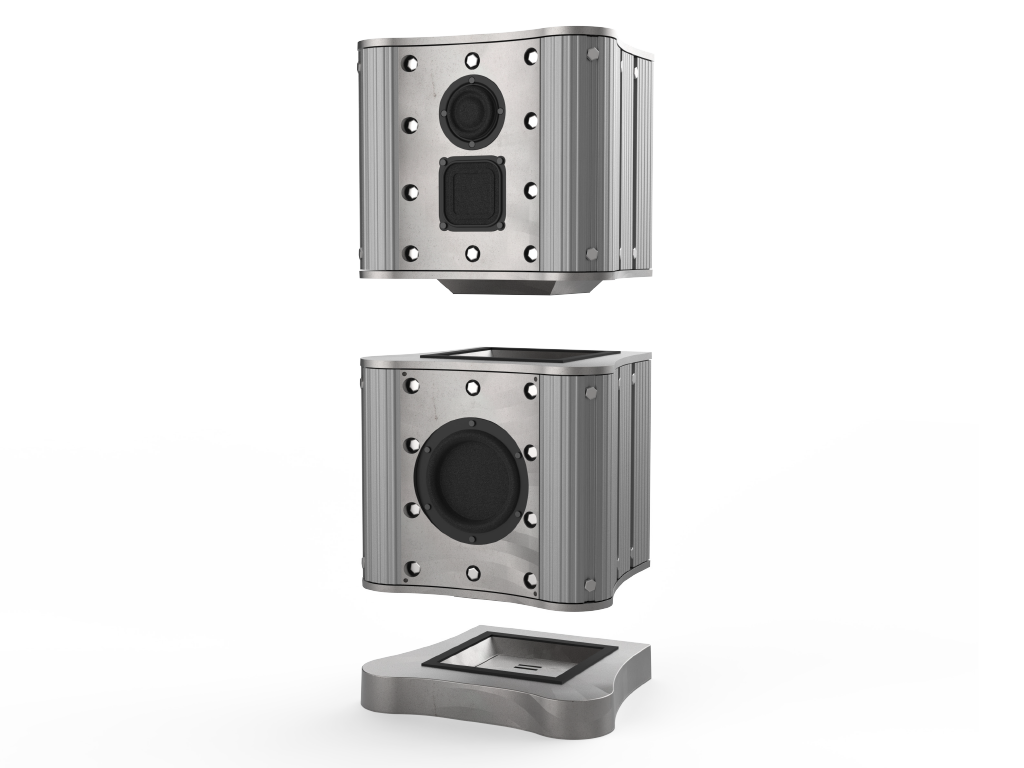
Alumax consists of two main components: The Enclosure + The Power Base
Bio
Jeremiah Royal is an emerging designer from Sydney, driven by a strong attention to detail and an eagerness to tackle new challenges. His design philosophy revolves around the belief that excellence in design emerges from a holistic approach, drawing inspiration and insights from a diverse range of fields and practices.
His studies have equipped him with a broad spectrum of knowledge and skills, including crafting a wooden stool, designing an additively manufactured hiking grip, developing an automatic paper towel dispenser, and, most recently, working on a repair-focused speaker enclosure for his honours project. These diverse experiences have made him adept in sketching, CAD software, Adobe Suite, workshop fabrication, and Keyshot rendering.
Jeremiah firmly believes that continuous learning and exploring new technologies and domains open up fresh avenues for creative thinking. This approach broadens perspectives and fosters the development of innovative and practical solutions to design challenges.
previous project / next project
Copyright UTS Product Design 2026